


A strategic realignment in Western foreign policy raises trade tensions with U.S.
Canada has formally announced plans to recognize an independent Palestinian state at the upcoming 80th UN General Assembly in September, joining France and the United Kingdom in what appears to be a growing diplomatic divergence from U.S. policy on Israel and Palestine.
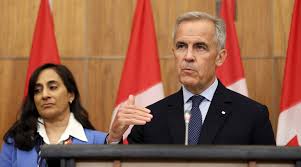
Prime Minister Mark Carney, alongside Foreign Affairs Minister Anita Anand, declared the decision during a press conference in Ottawa, reaffirming Canada’s longstanding support for a two-state solution. The move comes amid escalating global concern over Israel’s military operations in Gaza and the worsening humanitarian crisis.


“Canada has long been committed to a two-state solution,” said Carney. “Any path to lasting peace for Israel also requires a viable and stable Palestinian state.”
Canada Steps Into a Shifting Diplomatic Landscape
Western consensus fractures as allies prioritize Palestinian statehood
Canada’s pivot aligns it with European allies like France and the United Kingdom, both of which have announced similar intentions to recognize Palestine unless Israel commits to specific conditions — particularly a ceasefire in Gaza.
Diplomatic Shift Gains Momentum
France has publicly committed to recognition in September. The UK has also signaled its support, with new Prime Minister Keir Starmer stating Britain will move forward with recognition if Israel fails to meet peace-related benchmarks.
Canada’s inclusion in this emerging bloc of support marks a notable shift in G7 dynamics, as the United States — historically aligned with Israel — finds itself increasingly isolated on the issue.
U.S. Backlash Threatens Canada Trade Talks
Trump responds with threats amid sensitive economic negotiations
U.S. President Donald Trump reacted furiously to Canada’s announcement, posting on Truth Social:
“Wow! Canada has just announced that it is backing statehood for Palestine. That will make it very hard for us to make a Trade Deal with them. Oh’ Canada!!!”
This warning comes as Canada and the U.S. are locked in high-stakes trade negotiations, with a 35% tariff hike on Canadian goods looming if no deal is reached by August 1.
Trump’s response signals that foreign policy choices are now bleeding into trade diplomacy, raising the stakes for businesses and investors on both sides of the border.
Israel Condemns Move as “Reward to Hamas”
Sharp response from Tel Aviv as tensions rise over global criticism
Israel’s Foreign Ministry swiftly rejected Canada’s move, calling it a “reward to Hamas” that undermines efforts to achieve a ceasefire in Gaza and secure the release of Israeli hostages.
“The change in Canada’s position is a reward for Hamas and harms efforts to end the war,” the ministry said on social platform X.
Israel’s Ambassador to Canada, Iddo Moed, went further, claiming the move supports the establishment of a “jihadist state” that threatens Israel’s survival.
These statements highlight the growing rift between Israel and long-time allies, particularly those demanding accountability and humanitarian access in Gaza.
Palestinian Authority Promises Reform
Carney cites commitment to non-militarization and upcoming elections
In his announcement, Carney noted that Palestinian Authority President Mahmoud Abbas has committed to reforms that include:
-
Holding elections in 2026 with no role for Hamas
-
Non-militarization of the future Palestinian state
-
Governance reforms aimed at improving transparency and credibility
“The Palestinian Authority has committed to lead much-needed reform,” Carney emphasized. “That was a crucial part of our decision.”
This framework seeks to distinguish the Palestinian Authority from Hamas, and position it as a legitimate partner in future peace efforts — a message aimed at alleviating Israeli and Western security concerns.
Gaza’s Humanitarian Collapse Drives Urgency
International pressure mounts over starvation and aid access
Canada’s move is also a response to the intensifying humanitarian disaster in Gaza. The ongoing conflict has resulted in thousands of civilian deaths and widespread hunger, exacerbated by Israeli restrictions on humanitarian aid.
On Wednesday, 60 Palestinians were reportedly killed and 600 injured after Israeli forces opened fire near an aid distribution site in northern Gaza, according to the Gaza Ministry of Health. The IDF claimed it fired warning shots and was unaware of casualties, pending investigation.
This incident further underscores the growing frustration among Western nations over Israel’s tactics in the war — a frustration that is increasingly shaping diplomatic decisions.
A Coordinated Western Strategy?
Canada, UK, and France unite as pressure campaign grows
France welcomed Canada’s move, with President Emmanuel Macron signaling support for a broader diplomatic strategy. A statement from the Elysee Palace read:
“We will continue our efforts to encourage others to join this momentum in the run-up to the General Assembly in September.”
Canada’s decision came shortly after a call between Carney and UK PM Keir Starmer, where the two discussed Gaza’s humanitarian crisis and diplomatic strategies regarding Palestinian recognition.
This coordination suggests the emergence of a strategic European-North American coalition aimed at reshaping the discourse around Israel and Palestine — one increasingly at odds with U.S. policy.
Business and Political Implications
What CEOs, investors, and global leaders need to monitor
The fallout from Canada’s recognition announcement may impact several sectors:
Trade & Investment
-
Canadian exports to the U.S. may face punitive tariffs if Trump follows through on threats
-
Multinationals with cross-border supply chains should brace for regulatory uncertainty
-
U.S. investors may see increased political risk in Canadian markets
Energy & Defense
-
Canada’s move could affect joint defense projects, particularly in aerospace
-
Energy deals and infrastructure projects with U.S. partners may face delays
Reputational Risk
-
Brands and executives may be forced to take public stances on contentious geopolitical issues
-
Global firms operating in the region should prepare for consumer and media scrutiny
What Comes Next?
September vote could redefine global alliances and Middle East policy
The next flashpoint will be the UN General Assembly in September, where Canada, France, and the UK may collectively recognize a Palestinian state — a symbolic but geopolitically seismic event.
The implications are significant:
-
U.S. leadership in Middle East diplomacy may be diluted
-
Israel may face deeper international isolation
-
The Palestinian Authority could gain new legitimacy on the global stage
But serious challenges remain: internal Palestinian reform, security guarantees for Israel, and a credible roadmap to peace.
A Fork in the Road for Global Diplomacy
Canada’s bold move may redefine the foreign policy landscape of the West, setting the stage for new alignments and tensions. As war continues in Gaza and diplomatic relations evolve, CEOs, policymakers, and global institutions must stay agile, informed, and prepared for cascading political and economic consequences.

